


Due to the unfortunate fact that many people have allowed themselves to relegate all memories of the traumatic 2008 systemic crisis into the dustbin of history, certain fatal blind spots now exist preventing the majority of Americans from understanding what, and who is actually orchestrating the next phase of collapse which we are now living through.
As such, I felt obliged to write the current series now underway:
In Part I, I discuss what exactly are the true origins of China’s so-called “Social Credit System”, to which Project Stargate and Goldman Sachs play a central role.
Readers can access the summary of Part I below:
In Part II, I discuss the role of Goldman Sachs in Engineering the Global Financial Crises (and infiltrating China’s economic system), including the engineering of the 2008 crash that had global consequences and thus called for global reform overseen by Henry Paulson as U.S. Treasury Secretary, a former CEO of Goldman Sachs.
Part III of this series will be coming out this week, but before that happens, I wanted all readers to have access to the thesis outlined in Part II of this series which is contained in the summary below:
Core Ideas Developed in Part 2
-
What was Goldman Sachs’ central role in promoting deregulation, complex financial instruments, and privatization, which enabled repeated financial crises (especially 2008) while positioning itself for global dominance through control of national infrastructure and banking.
-
The historical context of the age of radical deregulation under Reagan (”Reaganomics”) and Thatcher (”Thatcherism”) which shifted finance toward “free markets,” and deregulation leading to risky investments.
-
What was the Savings & Loan crisis which cost taxpayers $124 billion; why was it that executives faced jail time in the 1980s, whereas no one was jailed after the 2008 crisis despite the scale of the criminal fraud being so much greater?
-
How did Goldman Sachs advise the UK on privatizing state-owned industries (telecom, utilities, etc.), handling nearly all cases and expanding this model across Europe and how was this tied to the anti-nation state policy of the Euro, and NAFTA which stripped nations of their sovereignty while devolving power into the hands of a supranational corporate financier oligarchy?
2008 Crisis Mechanics (Securitization Food Chain):
-
Within part 2, I outlined the anatomy of the fraud which followed a criminal formula involving lenders selling mortgages to investment banks → who then bundled toxic sub-prime mortgages into Collateralized Debt Obligations→ which were then sold to investors with AAA ratings from paid ratings agencies.
-
After this was accomplished, select banks (led by Goldman Sachs) bet against these toxic assets via credit default swaps (e.g., from AIG), profiting when they failed while recommending them to clients.
-
Goldman Sachs (under then CEO Hank Paulson) sold over $3.1 Billion worth of toxic CDOs in 2006, bought $22B in Credit Default Swaps from AIG, and created derivative instruments where client losses directly profited Goldman.
-
Goldman succeeded in this vast criminal conspiracy by lobbying to relax leverage limits (permitting leverage ratios of 33:1) profiting immensely from the crash.
Post-Crisis Continuity:
-
Part 2 showcased how Obama’s presidential campaign ran on the promise to increase regulation and investigate those responsible for the 2008 crash. However, once he was elected, his most senior advisors in his Administration were in fact the very people who had built the Ponzi structure. Obama had hired the architects of the 2008 crash, allowing them to cover up their trail while holding government positions.
-
By mid 2010 not a single senior financial executive had been criminally prosecuted or even arrested. No special prosecutor had been appointed. Not a single firm had been prosecuted criminally for securities fraud or accounting fraud. The Obama Administration made no attempt to recover any of the compensation given to financial executives during the bubble.
-
My article links this to broader patterns of privatization, “controlled disintegration,” and influence on China via Paulson’s U.S.-China dialogues. Paulson’s role in running the dominant infiltration of Wall Street banking ideology into China and China’s efforts to undo this damage is also introduced.
On Paulson’s role in the banking war against China’s sovereignty
-
-
During his time at Goldman Sachs, Paulson had made a lot of inroads amongst certain Chinese political elites. It is reported that during this time he had visited China more than 70 times. This was during a time when China was being heavily courted by the United States to adopt free-market reforms.
-
Paulson was especially interested in U.S.-Chinese relations as Treasury Secretary and was known to have persuaded President George W. Bush to allow him to spearhead and lead the U.S.-China Strategic Economic Dialogue, a forum and mechanism under which the two countries addressed global areas of immediate and long-term strategic and economic interest.
-
That is, in the midst of America’s own economic crash that would reach a peak-pitch one year later, Paulson was organizing hard to bring China further into free-markets, deregulation and derivatives.
-
Recall Goldman Sachs’ central role in credit default swaps, speculation on bad CDOs they were in fact giving high ratings to and encouraging their clients to invest in, and insuring themselves against the collapse of AIG that they knew was coming and were complicit in. This was all happening under Henry Paulson, who was the CEO of Goldman Sachs from 1999 to 2006. The highest paid man on Wall Street.
-
Basically, Bush had hired one of the central engineers of the 2008 crash as U.S. Treasury Secretary! And this man was in turn traveling to other parts of the world, with an especial focus on China to spread the disease. Recall that the disease had already been spread throughout Europe during the 1980s as per Goldman Sachs’ own biography.
-
And it was under Paulson, as U.S. Treasury Secretary, that he was positioned as the central architect of the 2008 bank bailouts (such as TARP – Troubled Asset Relief Program). In other words, he decided the reorganization of the entire American financial system, who was going to come out on top, who was going to sink to the bottom, and who was going to acquire whom. In fact, in the midst of the economic crash, Paulson as Treasury Secretary continued in his role of giving bad advice to investors, claiming everything was for the most part under control and that there was no cause for serious concern, certainly nothing that should influence what investors were already investing in.
-
With the passage of H.R. 1424, Paulson became the manager of the United States Emergency Economic Stabilization fund. He also became a member of the newly established Financial Stability Oversight Board that oversaw the Troubled Assets Relief Program (TARP).
-
Ironically, the radical free-market proponent Hank Paulson, was very hands-on indeed in organizing financial reform and restructuring as U.S. Treasury Secretary, of course, only after it was too late to avoid the full brunt of an economic crash that is. Leading up to the crash, however, Paulson took a remarkably hands-off approach.
-
Although China would be hit hard by the reverberations of America’s 2008 crash, they had not followed Paulson’s “advice” to the degree that he wished them to do so. We will talk more about how China escaped free-market “shock therapy” in Part III of this series.
-
As a broader critique, my paper describes a revolving door between Goldman, government, and regulators; and I emphasize the importance for renewed regulation if we are to avert a major catastrophe which entails the restoration of Glass-Steagall, breaking up the ‘Too Big to Fail’ model and accountability.
-
Just like derivatives, such as credit-default swaps, P2P loans were an Anglo-American creation (discussed in Part I) made up of complex algorithms to mask their true nature. Using the veneer that they were created to lessen economic hardship; they were in fact created to drive the knife ever deeper.
-
Recall in Part I of this series that Goldman Sachs is the common denominator linking BlackRock (GIP), Project Stargate, Open AI, Microsoft, Alibaba, Tencent and SoftBank. The fact that Goldman Sachs was at the center of engineering the 2008 crash and overseeing financial and banking reform in its wake should be viewed in direct connection to these other projects.
-
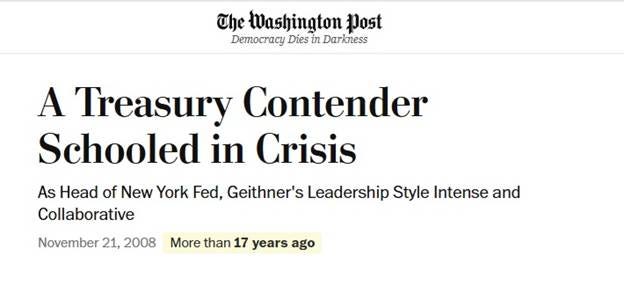
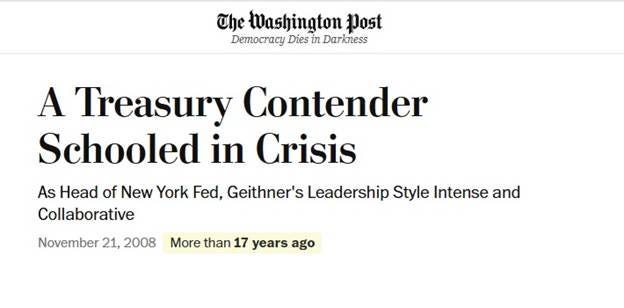
Tim Geithner served as the President of the Federal Reserve from 2003 to 2009. As President of the New York Fed, Geithner was a central figure in the U.S. government’s response to the 2008 financial crisis.
-
Earlier in his career, Geithner had served in the Clinton Adminstration’s Treasury Department, where he helped manage (or perhaps engineer) financial crises in Brazil, Mexico, Indonesia, South Korea and Thailand In other words, Geithner was the point-man to manage international financial crises of the 1990s as a senior official in the Clinton Treasury Department.
-
This would have most notably included the Asian Crisis that tsunamied into Asia in the late 1990s, hitting Japan the hardest and leaving in its wake a wave of suicides. The Tiger Economies of South Korea, Indonesia and Thailand were also hit hard. Ironically, or not so ironic if you understand how the game is played, these were among the most westernised economies in Asia. In other words, they were the economies that most readily adopted western radical free-market reforms.
-
The causes for this Asian crash went as far back as 1993. In that year, the Asian Tiger Economies – South Korea, Thailand, Indonesia – implemented a policy of aggressive deregulation of their capital accounts and the establishment of international banking facilities, which enabled the corporate and banking sectors to borrow liberally from abroad, the first time in the postwar era that borrowers could do so. In reality, there was no need for the Asian Tiger Economies to borrow money from abroad. All the money necessary for domestic investment could be created at home.
-
As a result of the Asian Crisis, these economies had to further succumb to the orders of the Western financial diktat in how they were to reorganise their financial and banking sectors. The crisis was treated as proof by the western financial institutions that Asia still had much to learn. What was the medicine prescribed? Further deregulation of course!
-
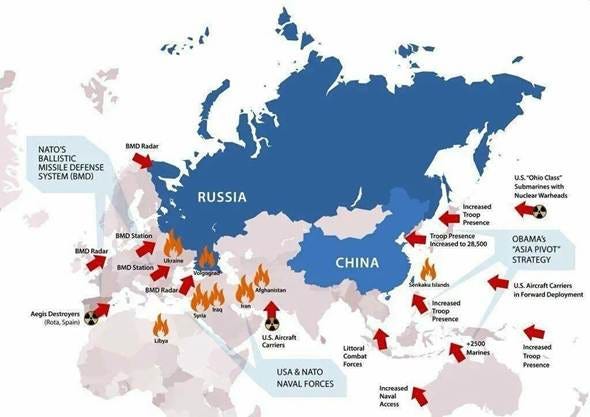
Geithner as U.S. Treasury Secretary under Obama – who along with Hillary Clinton as Secretary of State and Jake Sullivan as Director of Policy Planning and Deputy Chief of Staff would organise hard in their Pivot to Asia stance – actually had the nerve to blame China for America’s 2008 crash.
-
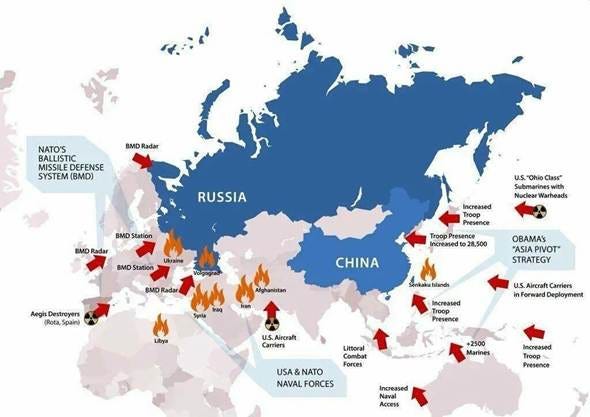
Instead of Obama focusing on addressing the underlying causes of the 2008 crash like he had campaigned on, that was the result of behemoth levels of fraud committed by the highest most powerful financial institutions in the United States…he decided to turn his attention to China and began increasing a military encirclement of the country.
-
Perhaps this was punishment for China not following the advice of Henry Paulson in setting up their own hangman’s noose, aka radical free-market reforms?
Part III Coming Out This Week: “How China Escaped Shock Therapy: From George Soros and Tiananmen Square to the Battle Against Big Tech’s Attempted Banking Coup”
.