
You can read the First Instalment here:
And the broader series here:
In the first instalment the story of how Zhao Ziyang was at the center of the inflation and corruption crisis that hit China by the late 1980s was discussed. As well as the central role of his think tank the System Reform Institute (which was directly tied to George Soros’ China Fund) in orchestrating this and how it held over 110 meetings with George Soros in Eastern Europe along with pro-shock therapists from China during these years. It was also discussed how Soros organized for the System Reform Institute to tour Latin America as an economic study case for China, with a focus on Brazil’s military dictatorship and Pinochet’s Chile. The two leading members of this think tank Chen Yizi and Wang Xiaoqiang, disciples of Zhao Ziyang, were on record as being very favorable to these two economic models.
Thus, not only was Zhao Ziyang and his think tank the System Reform Institute responsible for the inflation and corruption crisis that would later spark the Tiananmen Square protests but there was a serious study of Latin American military dictatorships as economic/political models to be used for China (one of them being a direct result of shock therapy) with the direct guidance and funding by George Soros.
It is here that we will resume our story.
Alvin Toffler’s Third Wave, Futurists of Beijing and the Dawn of a New Civilization
“A new civilization is emerging in our lives, and blind men everywhere are trying to suppress it. This new civilization brings with it new family styles; changed ways of working, loving, and living; a new economy; new political conflicts; and beyond all this an altered consciousness as well…The dawn of this new civilization is the single most explosive fact of our lifetimes.”
— Alvin Toffler, from The Third Wave (1980)
Alvin Eugene Toffler (October 4, 1928 – June 27, 2016) was an American futurist and businessman known for his works discussing modern technologies, including the digital revolution and the communication revolution, with emphasis on their effects on cultures worldwide. He is regarded as one of the world’s outstanding futurists.[1]
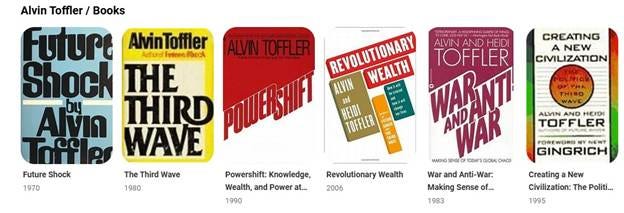
After writing Future Shock (1970) which became a world-wide best-seller, Toffler and his wife Heidi wrote The Third Wave (1980). In it, he foresaw such technological advances as cloning, personal computers, the internet, cable television and mobile communication. His later focus, via their other best-seller, Powershift (1990), was on the increasing power of 21st-century military hardware and the proliferation of new technologies.
He founded Toffler Associates, a management consulting company, and was a visiting scholar at the Russell Sage Foundation, visiting professor at Cornell University, faculty member of the New School for Social Research, and a White House correspondent.[2] The McKinsey Foundation (from the notorious McKinsey & Co. discussed in Part I of this series) gave him their Book Award for Contributions to Management Literature.
As we will see, the relevance of New School will be at the center of the networks supportive of Zhao Ziyang and what he was attempting to bring about.
In Future Shock, Toffler writes about his prediction that as this “new civilization” emerges, many will suffer something akin to culture shock, and will be disoriented, even upset, by this new strange environment. He called this “future shock.”
Toffler wrote:[3]
“We must search out totally new ways to anchor ourselves, for all the old roots—religion, nation, community, family, or profession—are now shaking under the hurricane impact of the accelerative thrust.”
In Toffler’s The Third Wave, he describes three types of societies, with each “wave” pushing aside the older society and culture. The “First Wave” is described as the agrarian revolution, the “Second Wave” the industrial revolution, the “Third Wave” he described as the post-industrial society which would be a scientific/technological revolution.
Chinese Premier Zhao Ziyang was greatly influenced by Toffler.[4] He convened conferences to discuss The Third Wave in the early 1980s, and in 1985 the book was the No. 2 best seller in China.[5]
Toffler often visited with dignitaries in Asia, including China’s Zhao Ziyang, Singapore’s Lee Kuan Yew and South Korea’s Kim Dae Jung, all of whom were influenced by his views as Asia’s emerging markets increased in global significance during the 1980s and 1990s.[6]
‘In 1980, Ted Turner founded CNN, which he said was inspired by Toffler’s forecasting the end of the dominance of the three main television networks. Turner’s company, Turner Broadcasting, published Toffler’s Creating a New Civilization in 1995. Shortly after the book was released, the former Soviet president Mikhail Gorbachev hosted the Global Governance Conference in San Francisco with the theme, Toward a New Civilization, which was attended by dozens of world figures, including the Tofflers, George H. W. Bush, Margaret Thatcher, Carl Sagan, Abba Eban and Turner with his then-wife, actress Jane Fonda.’[7]
As we will see, George Bush Sr. and Margaret Thatcher will play prominent roles in this story as well as Mikhail Gorbachev.
Describing his thesis in 1978, Toffler spoke of the emergence of the Third Wave and obsolescence of industrial civilization saying:
“This era is now screeching to a halt. Industrial civilization is now in a state of terminal crisis, and a new, radically different civilization is emerging to take its place on the world stage … We are swiftly entering a new, more sophisticated state of evolutionary development based on far more advanced yet more appropriate technologies than any known so far.
This leap to a new phase of history is bringing with it new energy patterns, new geopolitical arrangements, new social institutions, new communications and information networks, new belief systems, symbols, and cultural assumptions… Thus it must generate wholly new political structures and processes. I fail to see how it is possible for us to have a technological revolution, a social revolution, an information revolution, moral, sexual, and epistemological revolutions, and not a political revolution as well …. In this sense the breakdown of government as we have known it-which is to say representative government… is chiefly a consequence of obsolescence.
Simply put, the political technology of the industrial age is no longer appropriate technology for the new civilization taking form around us. Our politics are obsolete.”[8]
Matthew Ehret writes in “How China’s Gorbachev Was Flushed in 1989”:[9]
“One influential scientist who is given credit as architect of China’s One Child Policy and close collaborator of Zhao is Song Jian, a missile scientist who was trained in Norbert Wiener’s Cybernetics theory while studying in Russia in the 1950s. After attending the 7th World Congress of the International Federation of Automatic Control in Finland in 1979, Song was introduced to the Club of Rome’s Limits to Growth. According to researcher Robert Zubrin, Song immediately translated the book into Chinese without attribution to the original authors, and immediately used its linear models to compute the trend in population, pollution and resource loss over the course of a century concluding that China’s optimal population (aka: “Carrying Capacity”) to be on the order of 650-700 million (nearly 300 million fewer than the total population of his own time). These Club of Rome ideas spread like fire and were soon adopted as Chinese policy resulting in one of the worst instances of decades-long infanticide in history with a population reproduction rate that has not even begun to recover 40 years later (despite the wise removal of one child limits in 2016 and two child limits this year).
As Cambridge researcher Julian Gewertz noted in his 2019 study ‘Futurists of Beijing’, working as head of China’s State Science and Technology Commission, Song interfaced closely with Zhao to keep China’s science policy thinking tied to Club of Rome systems thinking.[10]
Another figure who was instrumental in bringing Alvin Toffler’s ideas to China was a senior researcher at the Chinese Academy of Social Sciences named Dong Leshan who spent months touring the USA where he met with the futurist. Describing his tour in 1981, Dong wrote: “Everyone I met and with whom I discussed American intellectual trends talked about [Toffler’s] book The Third Wave”
Dong immediately organized the ‘Chinese Society of Future Studies’ to formally invite Toffler for his first trip to China months later whereby Toffler wrote to Dong requesting “meetings and interviews with your leading political figures and with persons responsible for long-term planning”. At the top of the list was Zhao Ziyang.
In March 1983, a Chinese publishing house called Sanlien translated the first Chinese edition of Toffler’s Third Wave and a scandal immediately arose… The mystical idea of social evolution outlined by Toffler, was merely a reformed eugenics masquerading under the guise of Transhumanism which posited that not ideas or intentions but rather blind amoral forces were propelling human civilization towards higher states of complexity. These blind fatalistic “forces” were devoid of human intention and were moving our species inevitably through waves of development which included socio-political dynamics assigned to each wave (i.e.: First Wave = agricultural / feudal / pre-national, Second Wave = industrial / democratic / national, Third Wave = information / technocratic-feudal / post-nation state.)”
In a major speech delivered to officials at China’s State Council on October 9, 1983, Zhao Ziyang as Premier of China stated:
“Toffler’s Third Wave has a similar view. He believes that today’s Third World countries may not have fully experienced the ‘Second Wave’ of development, but that they can take an entirely new route to achieve a ‘Third Wave’ civilization.”
Mattew Ehret writes:[11]
‘The major insight offered by Toffler and his Chinese followers during this period was that China (and other underdeveloped nations) could skip the second wave of dirty industrialization and leap straight from the first to the third wave.
…All China required were “special economic zones” on the coasts for the purpose of importing raw and semi-finished material from abroad, clusters of low-wage labor intensive, low tech factories to transform those materials into finished goods in order to then be shipped back out to the consumer markets in the first world abroad. Money acquired by these means could be invested into third wave science programs with a focus on genetic engineering, artificial intelligence and information systems which were Zhao’s three priorities for China’s future. All considerations of large-scale development driven by great projects and concrete goals that could shape science priorities were banned in the minds of “bottom up” free market theories promoted by Zhao, Kissinger and Toffler.
Historian Michael Billington has noted that the Trilateral Commission directly organized a conference in Beijing in 1981 in order to keep China locked into this feudal model writing:
“In May 1981, David Rockefeller chaired an international conference of the Trilateral Commission held in Beijing. At that meeting, Chase Manhattan Bank’s chief, William C. Butcher, told the Xinhua news agency that China’s reform would only succeed if they rejected large industry or great development projects in favor of labor-intensive production. Heavy industry and infrastructure, he said, “take two great things, a great deal of energy and a great deal of money, neither of which are abundant in China.”
Another of Toffler’s heresies which led to a brief banning of his book in 1984 was the idea that politics should be severed from economics. In Toffler’s mystical worldview, the “force” of technological progress was of an evolutionary variety that could only be held back when human intentions meddled with it via political agendas and moral considerations. Zhao spent years arguing with the Politburo that economics be “liberated” from politics earning him the ire of statesmen recognizing the evil that was infusing itself into China.’
To clarify here, Zhao Ziyang’s attempt to implement what he called the Coastal Development Strategy during the years of 1987-1988 had major structural and philosophical differences to what Deng Xiaoping was originally putting forward as the Special Economic Zones (SEZs) beginning in 1979-1980 which included four geographically confined zones: Shenzhen, Zhuhai, Shantou and Xiamen.
The core difference between the two was that Deng’s SEZs were built to keep separate from the interior of China, namely to prevent overt western influence, foreign currencies, and unregulated labour from entering China’s centrally planned domestic economy while allowing China to learn trade and industry practices from the West and attract foreign direct investment.
Zhao’s economic model was called “Both Ends Abroad” and planned to incorporate the entire eastern coastline of China, spanning a vast region inhabited by nearly 200 million people at the time. He aimed to turn the entire maritime periphery of China into an open economic macro region.
Zhao wanted to use the coastal zones to actively transform and dismantle central planning in China’s interior. In Zhao’s model, as the coastal provinces boomed from international trade, they would buy agricultural products and industrial inputs from the poorer interior provinces. This would pull the interior into a market-driven economy, forcing the country to abandon price controls and central mandates in favor of raw market competition.[12]
Deng Xiaoping did ultimately make a turn around on this with his famous 1992 Southern Tour where he adopted a much closer approach to Zhao’s development strategy, effectively adopting Zhao’s entire economic playbook without calling to attention that that was what was happening. In truth, the original outline for the SEZs was likely steered by Chen Yun, not Deng Xiaoping. It is interesting that Deng makes this turn around tour the year Chen Yun fully retires. [See the First Instalment to this series for more on the debate between central planning with gradual marketization vs the push for package reform and shock therapy.]
Deng continued to refer to his economic plan as SEZ but it was in fact Zhao’s Coastal Development Strategy by 1992.
This 1992 Southern Tour opened the gates for western capitalism and finance to enter into China in a now extremely “open” atmosphere to free-market and privatization. China was effectively for sale to the highest bidders. This would be the era of Goldman Sachs’ dominance which will be discussed in Part IV of this series.
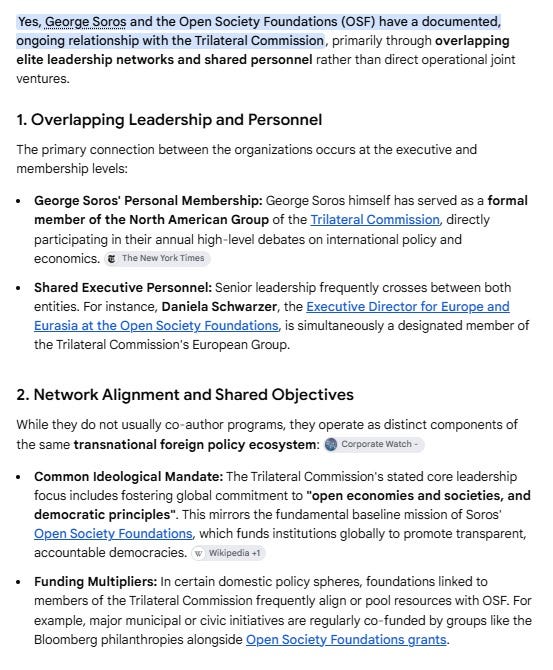
It should be noted here that George Soros’ Open Society Foundation has a close relationship to the Trilateral Commission.
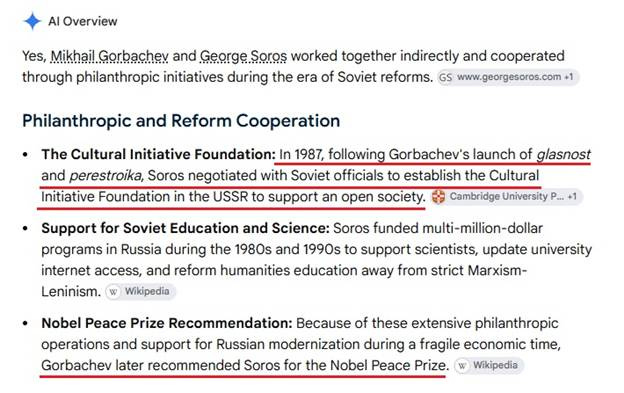
Mikhail Gorbachev was heavily influenced by Alvin Toffler and actively sought out Toffler’s advice to guide his restructuring policies (perestroika) and transition the USSR away from an industrial command economy.[13]
In fact, Gorbachev’s policies of glasnost (openness) and perestroika (restructuring) were deeply aligned with Toffler’s ideas that a society must become flexible, open, and technologically adaptive to survive.[14] [15]
In 1986, Gorbachev invited Toffler to the Soviet Union as part of the Issyk-Kul Forum—a gathering of global intellectuals convened by Soviet author Chingiz Aitmatov to introduce fresh, “non-doctrinal” thinking into the USSR.[16]
Even after the collapse of the Soviet Union, Gorbachev publicly maintained his respect for Toffler’s vision. In a later reflection on his memoirs, Gorbachev noted:
“I think that Alvin Toffler is right in many of his writings… they speak about the human civilization, which is entering a new phase of its development. And we must find a way to adjust to it… If we do not adjust, if we do not understand both the positive aspects and the dangers… that could be very dangerous.”[17]
Gorbachev was also heavily influenced by George Soros during Russia’s perestroika.
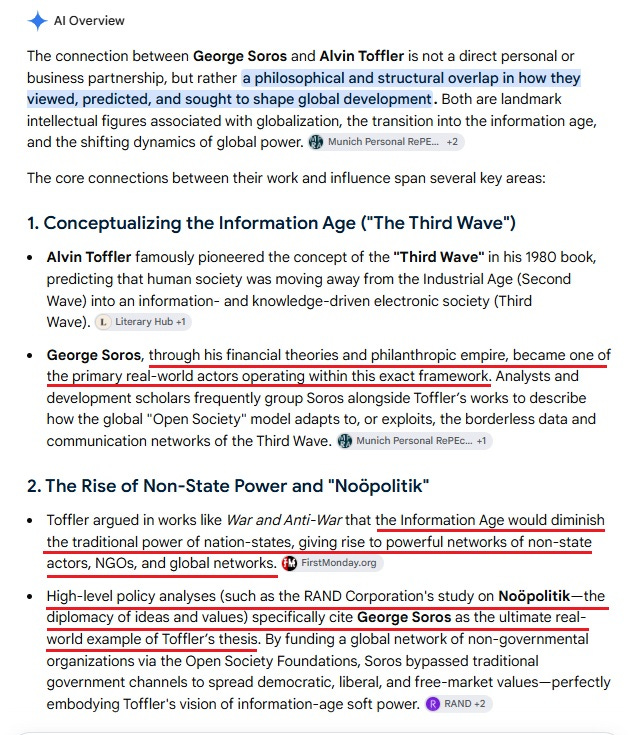
And the framework of George Soros’ Open Society itself is recognised as the “ultimate real-world example of Toffler’s thesis” by such think tank institutions as the RAND Corporation’s study on Noöpolitik.[18]
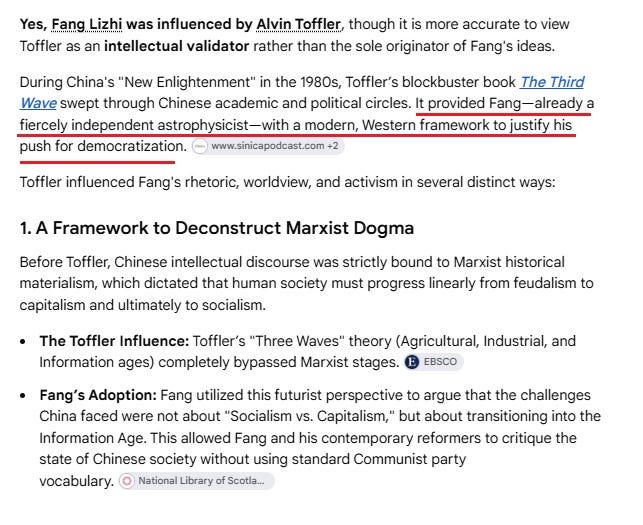
It is thus likely not a coincidence that the lead instigator for the student protests Fang Lizhi, astrophysicist and vice-president of the University of Science and Technology of China, happened to also be heavily influenced by Alvin Toffler’s vision for a “new civilization”…
Fang Lizhi was also a loud supporter of Zhao’s economic policies…
China’s New Enlightenment
Fang Lizhi is considered as one of the leaders of China’s New Enlightenment movement in the 1980s. No small feat when we realise that the decade of the 1980s has been referred to as the Age of New Enlightenment in China.[19] The theme of the New Enlightenment movement included a conceptually loose promotion of “democracy” and “science” and Fang Lizhi became the most prominent figure to represent these two ideals.
The movement also gave rise to a number of new literature genres such as the scar literature[20] and misty poetry[21]. Aesthetics also became a popular topic in society. You could say that there was a certain degree of similarity with these literature genres and that of the “Lost Generation” and the advent of existentialist writings. There is also a degree of similarity with the Frankfurt School which advocated that the new aesthetic should be that of ugliness and suffering since this more truly reflected “reality.”[22]
In addition, the birth of new music genres such as Chinese rock and the rise of the Chinese film industry all contributed significantly to the New Enlightenment.[23] You could say that the “New Enlightenment” was really just a promotion of anything Western, good and bad, with a good deal of the bad. Western popular science, Western existentialism, Western liberalism, and of course, Western counter-culture.
China was going through what the West had experienced over several decades – in one decade.
By Deng Xiaoping acknowledging that major mistakes were made during the Cultural Revolution, and that China had to reform, most notably in its economic approach, this had effectively opened the floodgates. For this was understood by everyone to also mean reform culturally speaking, even though these words were not specifically used. By condemning and arresting the Gang of Four who led the worse atrocities of the Cultural Revolution, the question was – what was the direction China should now take in shaping its cultural identity? Many thought the answer was clear, economically and culturally speaking, China needed to mimic what the West had been doing all along, which was a form of liberalism in everything it touched.
The two most notable leading figures of the New Enlightenment movement included the astrophysicist Fang Lizhi in a bizarre combination with the “Father of Chinese Rock” Cui Jian.
It was these two names that were most credited as shaping the ideas and the “vision” that inspired the students in the Tiananmen Square protests.
Cui Jian’s song “Nothing to My Name” (1986) was viewed as the beginning of Chinese rock music and as one of the most direct forms of “enlightenment” in China.[24] In fact, the song became the unofficial anthem for the 1989 Tiananmen Square protests with Cui Jian even performing it live for the students in May 1989 and doing what rock music does best with the youth, a catharsis for “general frustration” over the yearning for individual freedom. Of course, rock music has a universal attractiveness to youth no matter where they live. Youth living in privileged but mundane middle-class suburbia are just as inclined to feel frustrated over a vaguely defined “yearning for individual freedom.”
As Wu’er Kaixi famously said when asked what the students wanted to see as an outcome from these protests in the documentary The Gate of Heavenly Peace,[25] after a rather concerningly long pause of reflection as if this were the first time he was thinking about such a question, he stated
“So what do we want? Nike shoes, lots of free time to take our girlfriends to the bar, the freedom to discuss an issue with someone and get a little respect from society.”
He made this statement after the catastrophic event of June 3-4, 1989, when violence had reached a peak pitch, which makes it that much more disturbing. He was interviewed for the documentary sometime between 1990-1994 after he had been smuggled out of China through Operation Yellowbird with aid by the CIA and MI6. Apparently, he was the most costly of the student dissidents to smuggle out.
Wu’er Kaixi, who has been featured in Time Magazine on numerous occasions, as one of the most famous faces from the student protests, stated that during the protests at Tiananmen Square, Cui Jian and underground/rock music in general resonated on a much deeper level with the students than intellectuals like Fang Lizhi.[26]
This is likely true about the general sentiment amongst thousands of students, and people in general, who came from all over China to participate in the protests, and after the more moderate student leaders had been squeezed out. However, among the leaders of the students that gained control of the Square during this seven-week period, almost all of these student leaders were heavily influenced and even mentored by Fang Lizhi directly, as we will see shortly.
The New Enlightenment movement ended after the events of June 3-4, 1989, which was clamped down on by the Chinese government, seen as a major instigator for what led to the tragedy. This may seem like censorship and oppression of “free-speech” but the truth is that there was a great deal that justified viewing the New Enlightenment as consciously working for that tragic outcome, especially when we look at the actions of Fang Lizhi the lead instigator, who was directly protected by the CIA as well as British and American diplomatic channels after the events of June 3-4, as we will see in the Third Instalment of this series.
In fact, the New Enlightenment movement was not just a criticism of the Cultural Revolution or the Chinese Communist Party more broadly, it went so far as to criticize China’s entire traditional cultural legacy. An outright rejection of what it meant to be “Chinese” in the broadest terms, and the promotion of a Western identity entirely.
One very notable example of this sentiment was Liu Xiaobo, the West’s darling who was awarded the Nobel Peace Prize in 2010 for being a self-hating Chinese “intellectual.” Liu Xiaobo is also responsible for gathering a large crowd in Tiananmen Square which had almost entirely emptied out after seven weeks of going nowhere. This filling up of the Square occurred just a few days before the tragic events of June 3-4, 1989. The timing was so suspicious that even he acknowledges in the documentary The Gate of Heavenly Peace, that he hopes he wasn’t responsible for helping to bring about what took place that day. This will be discussed in greater detail later in this paper.
Liu Xiaobo was a notable scholar who published articles in the New Enlightenment Journal. This journal was also shut down after June 4, 1989.
One of Liu Xiaobo’s most controversial statements (which he stood by in his later years) was in an interview in 1988 stating:
“It took Hong Kong 100 years [under British colonialism] to become what it is. Given the size of China, certainly it would need 300 years of colonisation for it to become like what Hong Kong is today. I even doubt whether 300 years would be enough.”[27]
The Guardian writes:[28]
“Affirming this sentiment in Open magazine in 2006, he added that progress in China depends on westernisation and the more westernisation, the more progress. While his supporters excuse Liu’s pro-colonialism as a provocation, it logically aligns with his support for total westernisation and US-led regime changing wars.”
Liu admitted in an interview with Open Magazine that his 1988 response of “300 years of colonialism” was extemporaneous, although he did not intend to retract it, because it represented “an extreme expression of his long-held belief.”[29]
In another interview he stated that “to choose westernisation is to choose to be human.”[30] [31]
When discussing the River Elegy, an influential work of literature in the New Enlightenment movement that heavily criticized Chinese culture going back to the Ming Dynasty and was turned into an incredibly influential television documentary (the author Su Xiaokang was also smuggled out by Operation Yellowbird), Liu Xiaobo criticized the work for not being critical enough of Chinese culture and not advocating westernisation enthusiastically enough, stating:
“If I were to make this I would show just how wimpy, spineless and fucked-up [weisuo, ruanruo, caodan] the Chinese really are.”[32]
He supported U.S. President George W. Bush’s 2001 invasion of Afghanistan, his 2003 invasion of Iraq and subsequent re-election. Liu supported other U.S. interventions in the Middle East as well, alongside the Vietnam and Korean War.[33]
In his 2004 article titled “Victory to the Anglo-American Freedom Alliance,” he praised the U.S.-led post-Cold War conflicts as “best examples of how war should be conducted in a modern civilization.”[34]
Liu considered it most unfortunate that his monolingualism )he only spoke the Chinese language) bound him in a dialogue with something “very benighted [yumei] and philistine [yongsu],” referring to the Chinese cultural sphere.[35] Apparently, he could not be bothered to learn an actual western language despite all of his glorification of the west’s superiority over the east.
As we will see,[36] Liu Xiaobo’s western funders reveal a good deal, including his direct connections to the NED.
Suffice to say for now, Liu Xiaobo was the most prominent “adult” that was present at the Tiananmen Square protests for a significant period,[37] that was camping with the students for several days and influencing the dynamic within the Square, including being directly responsible for filling the Square with approximately a thousand people a day or two before the tragic events of June 3-4, 1989, when the Square had been nearly empty before his direct intervention.[38]
However, the most notable adult in the room influencing the students during this period was Fang Lizhi, who is recognised by almost all, including leading student dissidents themselves, as the main influence that shaped the Tiananmen Square protests first in 1986 and later in 1989.
The 1986 Student Demonstrations & the Matter of Hu Yaobang
After graduating from the Physics Department at Peking University in the 1950s, Fang Lizhi (1936-2012) joined the CPC, and started working at the Institute of Modern Physics. There he reportedly became involved in China’s secret atomic bomb program.[39] [40]
During the 1970s he held many academic positions, including the director of the astrophysics research group of University of Science and Technology of China (USTC), director of the science history research group, chief editor of the USTC academic journal, and chair of the Chinese society of gravity and relativistic astrophysics. In 1984, Fang was appointed as the vice president of the USTC. He was very popular among the students. Fang also began to write essays for publication in popular magazines and gave lectures on a variety of topics in universities, though usually not in USTC.
In December 1986, college students demonstrated in over a dozen Chinese cities for greater economic and political freedoms. Again, this was almost entirely influenced by the rampant inflation and corruption crisis as a direct result of the economic policies put in place by Zhao Ziyang, then Premier of China (for the details refer to the First Instalment of this paper.)
Fang Lizhi was at the center of these student protests as is acknowledged by all sides.
Deng Xiaoping, after almost two months of student demonstrations, named three Communist Party members to be expelled: Fang Lizhi, Liu Binyan, and Wang Ruowang. All three had played important roles in the New Enlightenment movement and Fang Lizhi and Wang Ruowang in particular were heavily influential in the 1986 student demonstrations, critical of the Chinese government’s lack of political and economic reform to address the crisis of inflation and corruption.[41]
The student protests lasted from December 1986 to mid-January 1987.
During this time astrophysics professor and vice president of the University of Science and Technology of China (USTC) Fang Lizhi was giving a series of lectures at universities in Shanghai and Ningbo in which he encouraged to “open in all directions,” à la New Enlightenment.[42]
The protests began at the campus of USTC, where Fang Lizhi was based, and spread quickly to other cities such as Shanghai, Tianjin, Nanjing, Kunming, Hangzhou, Suzhou, Guangzhou, and Beijing.[43] Throughout the demonstrations, broadcasts by the Voice of America became a key source of information for student protesters.[44]
Voice of America (VOA) has sat under the parent state-owned agencies U.S. Information Agency (USIA) and later the U.S. Agency for Global Media (USAGM). Though there is a denial of a direct connection to the CIA, it should be noted that Radio Free Europe and Radio Liberty were covertly funded and managed by the CIA as psychological warfare operations under Project Mockingbird[45] which is officially acknowledged. During the 1970s, they were stripped of official CIA funding after public exposure. They were subsequently transitioned to open Congressional funding and placed under the oversight of USAGM, the same agency that VOA is under. Take from that what you will…
Wikipedia writes:
“The goals of the protestors were portrayed in western media like The Washington Post [a known frontrunner for the CIA’s Project Mockingbird[46]] as being a pro-democracy movement but the students had many other grievances that had little to do with democracy and were reported by Hong Kong media.[47] [48] These grievances varied depending on the campus with students in Beijing protesting that lights were turned off after 11:00 whereas students in Nanjing criticized the inclusion of political studies in their curriculum.[49] The protesters also focused on the problem of corruption and cronyism in the government, which affected students abilities to gain employment and slowed Chinese economic growth.[50]
Again, the most serious issues were concerning the economic and corruption crisis that would reach a peak pitch in 1989 and were direct outcomes of Zhao Ziyang’s economic policy of the dual track price system that was supported by his think tank the System Reform Institute, which in turn was funded by George Soros (more on this shortly).[51] The 1986 student demonstrations were not a protest in favour of a “western democracy.”
The protests began in Heifei December 5, 1986, with thousands of students, then escalated and spread to Shanghai from December 19-21, 1986 with reportedly several thousand students. News spread largely due to the role of Voice in America. And this American “voice” was literally guiding the students towards an ultimate confrontation in China’s capital, Beijing.[52]
By late December 1986, students from elite institutions such as Peking University and Tsinghua defied government bans to march through Tiananmen Square, consisting of reportedly several thousand to tens of thousands of students. This caused Deng Xiaoping to actively clamp down on the protests.
Very significantly, the student protests were clamped down on through passive means, such as street blockades, it also helped that the weather was freezing cold. Arrests were made of dozens of non-student workers and “outside agitators” who joined the marches. There was no violence that was used and no students were arrested.
Deng also forced the resignation of CPC members, most notably Fang Lizhi, journalist Liu Binyan and writer Wang Ruowang as lead instigators and were stripped of their university and institutional posts. However, Fang Lizhi did retain his prestigious title as an academician of the Chinese Academy of Sciences until 1989.
The 1986 student demonstrations were ultimately a flop if the intention behind the “voices” was to create a violent confrontation between the students and the Chinese government.
However, there was one very successful outcome that would later be utilized to trigger the onset of the 1989 student demonstrations and that was the matter of Hu Yaobang’s forced resignation, who was then General Secretary of the CPC.
Deng had asked Hu Yaobang to enforce these resignations, which forced Hu to take a firm stance against the New Enlightenment movement to which he was sympathetic towards. Hu Yaobang refused to carry out the order and was thus also forced to resign from the CPC as a result.
Hu Yaobang appears to be a genuinely good and well-intentioned person, but also a touch on the naïve side. Following Mao’s death, Hu Yaobang became the head of the CPC’s Organization Department and launched a massive campaign to rehabilitate victims of the Cultural Revolution.
Among those rehabilitated was none other than Xi Jinping’s father, Xi Zhongxun, who had suffered a brutal 16-year political purge and was imprisoned. Hu personally intervened to overturn the erroneous verdicts against Xi Zhongxun, freeing him from his long political exile and paving his way for his return to top-tier leadership. Xi Zhongxun would rise to become one of the Eight Elders of China post-Mao.[53]
As a result of this, Xi Zongxun and Hu Yaobang formed a close and loyal friendship.
When Hu Yaobang underwent a series of hostile meetings amongst the party elders to force him to resign, Xi Zongxun is reportedly the only who vehemently defended Hu.
Although it was certainly uncalled for to create such hostility and psychological trauma forcing Hu to resign, Hu’s position in his overly sympathetic support and protection towards the New Enlightenment movement and his understanding of economic policy, pushing for ad-hoc high-speed economic reform, showcased a deep flaw in his understanding on such pivotal matters that were at the forefront of shaping China’s identity and direction. These were indeed major mistakes and misjudgements on the part of Hu that could not carry on with someone in such a high leadership position during a time of social upheaval.
By Hu refusing to carry out the forced resignation of key intellectual pillars to the New Enlightenment movement (Fang Lizhi, Wang Ruowang and Liu Binyan), he had confirmed to the Party that he lacked an understanding of how serious this matter truly was.
However, Hu Yaobang retained his prestigious membership in the CPC’s Central Committee, and that same year at the 13th Party Congress, was elected a member of the new Politburo.
As a consequence of this decision, Zhao Ziyang was named Hu’s replacement as General Secretary. Though this was institutionally considered a major promotion Zhao was reportedly unhappy with the decision. In his “audio memoirs” published posthumously as Prisoner of the State: The Secret Journal of Premier Zhao Ziyang, he made admissions that alluded to the fact that he did not want the position and reportedly asked Wang Zhen to intercede with Deng. Ultimately, he had no choice but to accept the position.
Zhao unhappy with this change in position makes sense when we understand that as Premier of China, he had direct authority over shaping economic policy. Recall from the First Instalment of this series that Zhao had been at the center of shaping the policies around China’s price reform, what would ultimately dictate China’s overall economic reform.
As General Secretary. Zhao was effectively removed from his control over shaping and implementing economic policy in China.
He also lost control over shaping enterprise restructuring and international trade. By Zhao being pretty much forced to take the role of General Secretary, he was thrust into an entirely different political sphere, one of party ideology, propaganda and factional mediation – areas where Zhao had little interest and far fewer allies.
From this standpoint, Zhao’s new position was indeed a demotion, removing him from a project that he had been carefully working on for several years – China’s entire economic reform.
Deng likely did this as a compromise to the opposition that was growing within the Party towards Zhao Ziyang. The crisis of inflation and corruption were only getting worse due to Zhao’s policies. Despite this Zhao continued on the same course. After the 1986 student demonstrations over these very issues, this gave further support within the Party that Zhao needed to be removed from his position.
Deng, Hu and Zhao had formed a trifecta up until this point. Between Hu and Zhao, Deng prioritised keeping Zhao in a position of power. Thus, Hu was sacrificed politically in order to divert attention from Zhao.
This is likely why the meetings with Hu were so psychologically abusive by Deng. It was to create a drama around this story, otherwise, Zhao would have most certainly been on the chopping block since he was directly responsible for the reasons why the students were protesting – on matters of the economy and corruption.
Hu Yaobang had been politically advantageous to Deng and Zhao’s “vision” since he was sympathetic towards things like the New Enlightenment movement and had led the rehabilitation of the victims of the Cultural Revolution. He had also stood up for the human rights of cultural minorities, including within Xinjiang and Tibet. He cared about matters of human rights and spoke out against totalitarian conduct by the CPC. The 1980s were viewed by Hu as a move towards human decency towards others.
However, the New Enlightenment movement was ultimately advocating for a western economic and political reform, which was promoted in the form of free-market and package reform (shock therapy).
Unfortunately, this made Hu an extremely useful tool in service to the call for shock therapy in China, which he did in fact support. I believe Hu didn’t really understand the real consequence in all of this. He wanted good things for the Chinese people but was fooled as to how this could be brought about.
The man who was positioned to replace Zhao Ziyang as Premier of China was Li Peng, a close ally of Chen Yun.
It is clear that Deng was forced to allow a member from the opposition (led by Chen Yun) to lead matters of economic reform as a result of the 1986 student demonstrations and overall situation of growing inflation and corruption.
During the Tiananmen Square protests in 1989, as we will see, lead student dissidents (who were again directly influenced by Fang Lizhi) held a great deal of direct support for Zhao Ziyang’s economic ideology and were extremely oppositional to Li Peng who would be nicknamed the “Butcher of Beijing” after the tragic events of June 3-4, 1989.
We will see if an honest account of this history merits such a nickname.
The West’s Theory of Relativity Applied to Historical Accountability
In 1989 Hu Yaobang died of a heart attack at the age of 73. At Hu’s memorial service his wife reportedly blamed his death on how harshly the Party treated him. At Hu’s funeral, according to Harvard’s Ezra Vogel’s account, when Deng offered his condolences, Hu’s widow directly confronted Deng and said “It’s all because of you people!”[54]
However, another account and likely much more reliable comes from Zhang Lifan who helped the Hu family organize the funeral proceedings. Zhang noted that while the scene between Deng and Li Zhao (Hu’s widow) was “intensely tense” it was not confrontational. Deng’s wife took her hand and said “Please take care of your health.” Hu’s widow responded with “Comrade Xiaoping should also take good care of himself. People always have to die; it is a law of nature.”[55]
That second account by Zhang Lifan, a close friend of the Hu family, is quite different from what Ezra Vogel writes. However, Vogel’s version is the most popular one and very much encourages a westerner to think that Hu’s widow had directly blamed the CPC for Hu’s heart attack at his funeral service.
Harvard’s Vogel’s coloring of events would be used to shape what the West understood, and even those within China, of Hu Yaobang’s death since there was really no other public account at the time. Hu would be celebrated by the western press as a champion for “western democracy” values, and that the CPC had caused him to go into political exile, the strain being too great he died of a heart attack. However, Hu was never politically exiled, he remained within the Politburo.
On this note it is important to clarify here the original sentiment of the youth when the student protests first began on April 15, 1989, the day Hu Yaobang died (his public funeral service was held on April 22, 1989).
In the beginning the student protestors were clearly motivated in calling for a purer, stronger socialism, not for “western democracy” as western press claimed. The details of this will be discussed in the Third Instalment to this series, however, for now I think it suffices to bring up these two facts.
Original banners held during the beginning of the student protests were written in Chinese, however, later on they were written in English and explicitly calling for a western democracy.
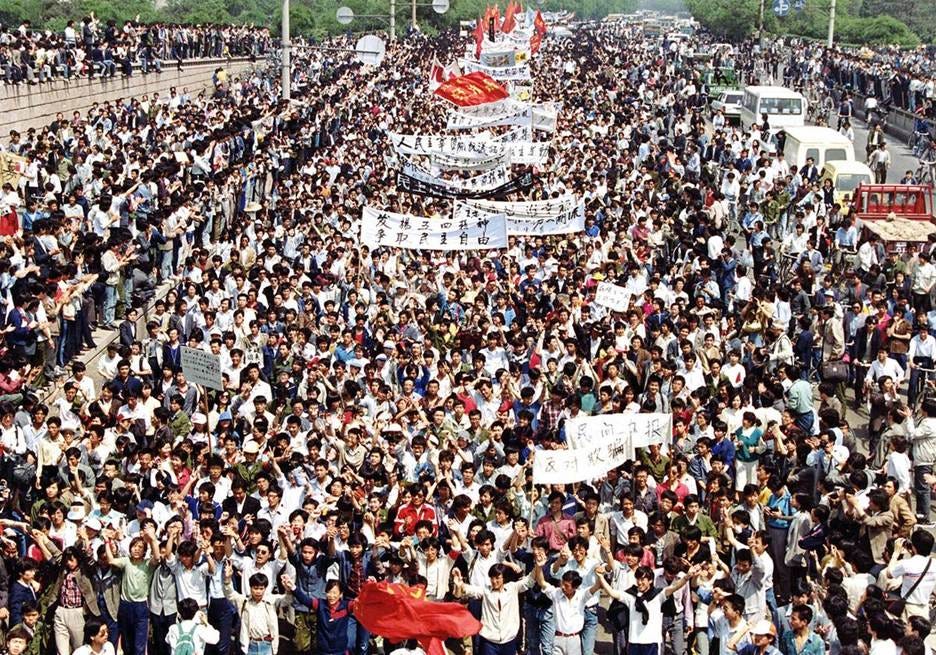
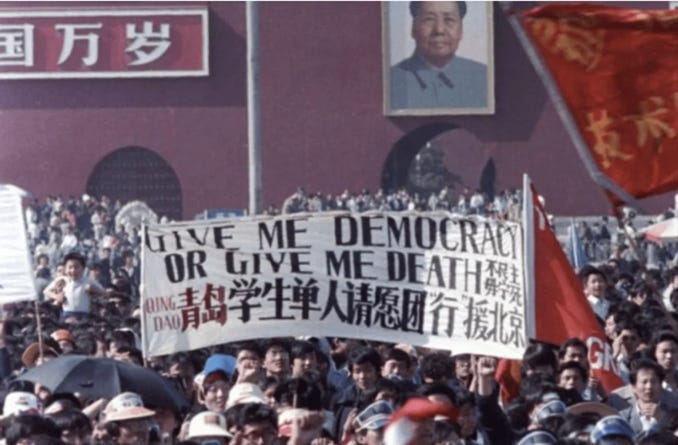
The above banner with the writing “Give me democracy or give me death”, a pastiche of the famous 1775 quote from Patrick Henry saying, “Give me liberty or give me death!” – this quote would have meant nothing to a Chinese student at the time but worked well for an English-speaking international media audience watching this on their television screens, which was of course the intended target.
This is further confirmed by a lead student dissident, Chai Ling, who also admitted that such a concept was entirely unfamiliar to Chinese students during the Tiananmen protests (this will be further discussed in the Third Instalment.)
Another revealing example that the students were in fact protesting for a purer ideal of socialism and not western democracy is seen by their choice of inspiration for their so-called “Goddess of Democracy”[56] as it was called by western press.
The students were advised, it is unclear by whom directly, to create a statue to represent the sentiment of the student protests. And as “good socialists” chose to make it as unlike New York’s realistic Statue of Liberty as possible, basing their sculpture on the highly stylized work of Russian revolutionary communist sculptor Vera Mukhina.
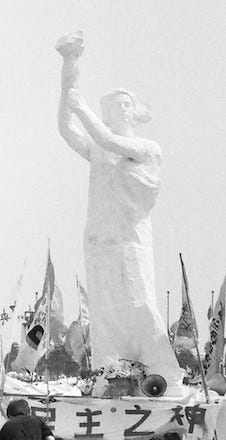
To a western audience viewing this on their television screens, this sculpture could be understandably viewed as creative inspiration taken directly from the “Statue of Liberty.”
But it wasn’t. It was directly inspired by Vera Mukhina’s “Worker and Kolkhoz Woman.” The students’ “Goddess of Democracy” sculpture was recreated in many western countries, with westerners entirely unaware of the strong pro-socialism message inherent in the stylized design.
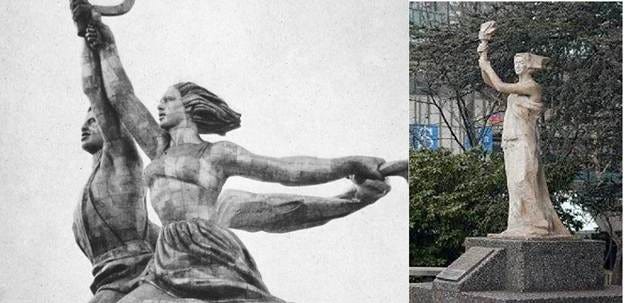
A sculptor present during its construction, Tsao Tsing-yuan, has written that the students decided not to model their statue on the Statue of Liberty because they were concerned that it would be unoriginal and “too openly pro-American.” Tsao further notes that the influence on the statue was based off of the work of Russian sculptor Vera Mukhina, associated with the school of revolutionary realism. Tsao confirms it was this piece “Worker and Kolkhoz Woman” that was especially influential for their statue’s head and facial features.[57]
So again to clarify, the student protests at Tiananmen Square in 1989, were once again motivated primarily on the issues of economic and corruption matters, as was the case for the 1986 student demonstrations. The students were calling for a purer socialism, more closely resembling the ideals of the Four Modernizations in practice and to correct the issues on a poorly performing economy (specifically on the crisis of inflation) and matters of corruption.
They were not calling for a complete overhaul of China’s government and to replace it with a western model nor were they calling for free-market or capitalism. They were socialists and supported a socialist government.
The reaction to Hu Yaobang’s death was not a call for anarchy and to tear everything down. It was a catalyst to call for a correction of what was viewed as China falling off the course of what they had originally set out in the Four Modernizations, what had been originally laid out by Zhou Enlai.
Zhou Enlai’s plan hinged on an over-all economic and industrial revolution driven by breakthroughs in 1) Industrial productivity, 2) Agricultural productivity, 3) Defense and 4) Scientific/Technological progress.
This was the original governing sentiment that launched the student protests in 1989.
However, as time passed leaders began to form among the student ranks and take-over the narrative. They even held full control over the megaphone in the Square. These lead student dissidents were all direct disciples of Fang Lizhi, except for the exception of Chai Ling, however her entourage including her then husband were all made up of Fang Lizhi disciples, whether she was aware of it or not.
Thus, the more moderate student leaders were pushed out and the narrative that came to dominate the discussions in the Square and reported to the world by western press became the teachings of Fang Lizhi through his student apostles.
The direct role of Fang Lizhi will be discussed in further detail in the Third Instalment, however, first I would like to address the main culprits in spreading the story that Li Peng was a bloodthirsty tyrant that was chomping at the bit to mow down the students in the Square (which by the way never happened). The details of the events that occurred on June 3-4, 1989, will be discussed in great detail in the Third Instalment to this series which includes the involvement of foreign intelligence. In this paper, I would like to focus on who was in control of the narrative.
Li Peng has been repeatedly called the “Butcher of Beijing” by western press, a nickname that has become almost synonymous with his actual name, ensuring he go down in the west’s version of history in absolute infamy.
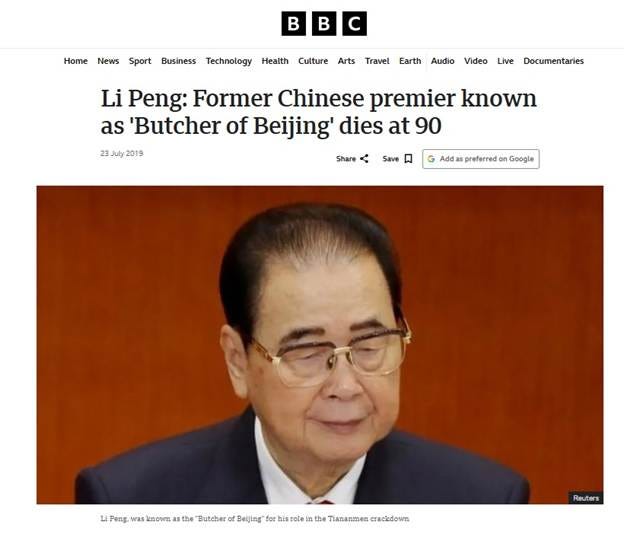
So, what was the reason that justified such a heinous nickname?
The main sources that claim that Li Peng ordered that violence be unleashed on the students and protestors more broadly, and that he apparently took great glee in his diabolical plot, comes from four dubious sources:
1. Zhao Ziyang’s “secret journal” that was of course smuggled out of China and published post-humously such that Zhao cannot confirm or deny its contents, titled “Zhao Ziyang’s Secret Journal (Prisoner of the State)”.
2. The “leaked” “official” Chinese archives on the event known as “The Tiananmen Papers” that were, of course smuggled out of China, and published in 2001.
3. And thirdly, apparently the diary of Li Peng himself who wrote, no doubt while frothing at the mouth, his absolute ecstasy in wishing nothing but blood and carnage on the student protestors during the military crackdown. This publication is titled “The Critical Moment: Li Peng’s Diaries” published in 2010 and was also smuggled out.
4. The last of these dubious sources is titled “The Last Secret” published in 2020, from smuggled out CPC documents of what is claimed to be the records of their Politburo meetings.
So what do we make of all of this.
Well for one, three out of the four publications: Zhao Ziyang’s reported diary, Li Peng’s reported diary and the CPC records of the Politburo meetings were all smuggled out and compiled by one man, Bao Tong, with aid by his son Bao Pu.
Bao Tong was Zhao Ziyang’s Policy Secretary throughout his entire career in the 1980s’, from when he was Premier of China, from 1980-1987, to his transition to General Secretary, from 1987-1989, until Zhao’s house arrest which came into effect May 28, 1989 (Zhao was never formally arrested or charged with a crime, and it was not a strict house arrest since Zhao could receive visitors and eventually was allowed to travel all over China – despite it sold to the west that he served a life-long sentence of house arrest.)
Bao Tong was arrested around this same time frame, end of May 1989, and was the highest-ranking CPC member to be arrested and imprisoned where he served a seven-year sentence.
The reason for this was due to their role in directly encouraging the students in their cause led by Fang Lizhi disciples (which as we will see, was effectively a promotion of Zhao’s return as Premier of China or at least his economic policies as dictated by these student leaders). This was seen as having the effect of undermining the actual Chinese government’s stance, which it most certainly was.
Zhao and Bao’s involvement with the student protests was occurring during the twilight hour before the June 3-4 mayhem. This was overlapping with the period where Liu Xiaobo successfully refilled the Square with thousands of students when it had almost completely emptied before his intervention.[58]
This was the reason for Zhao and Bao’s arrests, it was effectively a coup against Li Peng as Premier of China. As we will see, Li Peng became the focus of student leaders rage, not Deng Xiaoping, despite Deng being the paramount leader and head of the military.
So what was the declared reason for Bao Tong’s arrest. Well according to western accounts it was for “leaking state secrets” and “counter-revolutionary propaganda incitement”, the details on these charges and the evidence presented to support them appear to come from only one English source, Amnesty International[59] and has been backed by the Human Rights Watch.[60]
Amnesty reported that the Chinese authorities relied on “vaguely worded arbitrary state secret laws” and that no real evidence was presented. Thus, Amnesty felt itself justified to conclude that Bao Tong was a “prisoner of conscience” and imprisoned for his opposition to Li Peng’s diabolical plan to militarily crack down on the Square and mow students down (which again never happened). This was then adopted by the west as “the official narrative,” case closed.
[Note: I keep referring to the reference to mowing students down since that was the most popular narrative that remained dominant in the west’s comprehension of what happened for years, and for many westerners up to this very day. However, the truth did come out and the official western press account has been corrected, albeit quietly after they had blown on their horn the story of blood and carnage in the Square. The truth is that not one student or person for that matter was harmed in the Square. The students peacefully evacuated. Violence did occur in Beijing more broadly, again the details will be discussed in the following instalment. However, I would like to stress the point here that Zhao and Bao were being sold to western audiences as conscientious objectors to what they claimed was Li Peng’s desire to shed the blood of the students. This has now been proven false. Yet the story of Li Peng as a butcher continues.]
To reiterate, it was through Amnesty International with the support of the Human Rights Watch that this narrative of Zhao and Bao as “prisoners of conscience”, and not guilty of something actually sinister, was sold to the West.
Who is a primary funder of Amnesty International? George Soros.
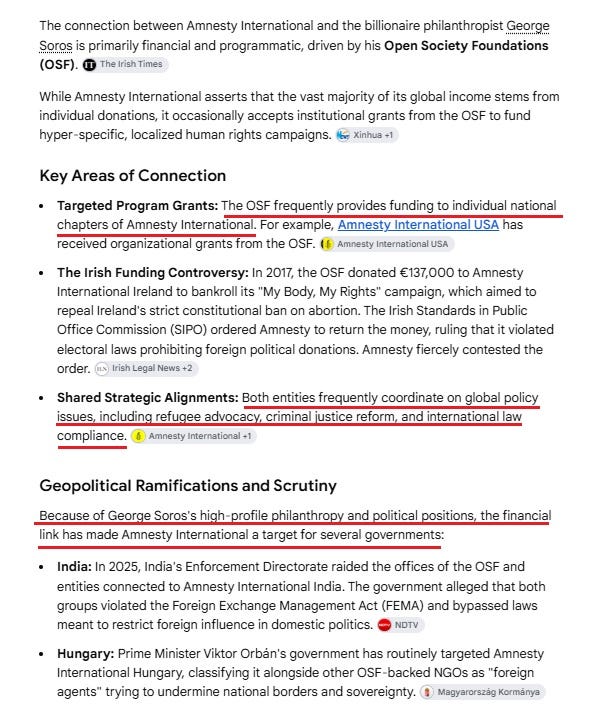
In the case of the Human Rights Watch their connection to George Soros is not only a question of primary funding but an actual partnership.
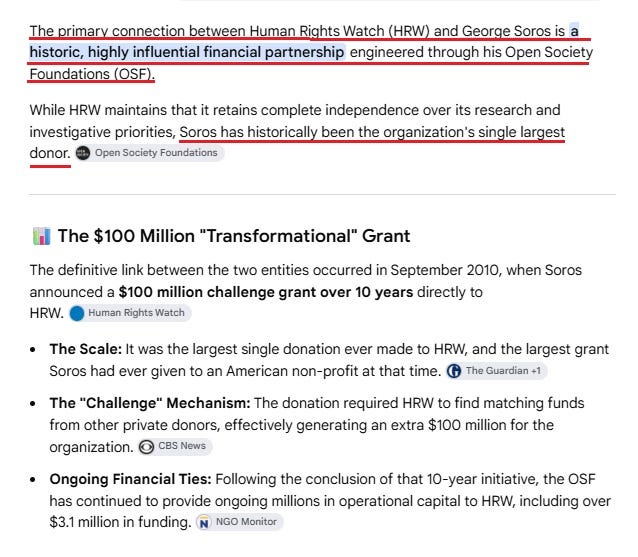
What was the evidence Amnesty International used to report their findings on Zhao and Bao?
Here is where it begins to feel like we are watching a dog chase its own tail.
The “evidence” for Amnesty International’s findings come from what they claim to be “official” Chinese government court verdicts and indictment documents, smuggled out or released in secret trials.
Good grief.
I would like to remind the reader at this point that in the First Instalment I went over in detail the connection between George Soros directly with Zhao’s think tank the System Reform Institute to which George Soros was funding. This is publicly and openly acknowledged to be the case!
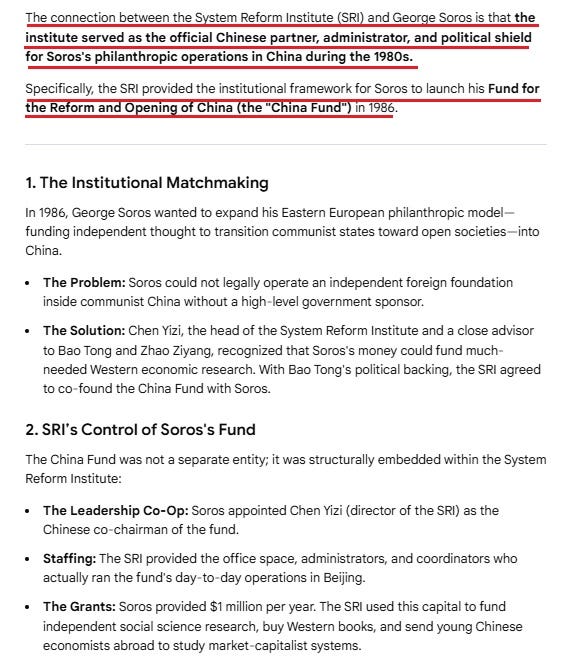
However, as to be expected, there is an attempt to spin this connection as a “political trap” concocted by the evil Chinese communist government in a “conspiracy theory” to blame Soros for the….actual economic policies he was directly enforcing, funding and dictating???
I think the right phrase we are looking for here is not “political trap” but “caught red-handed”. It is honestly on the same level of logic used by someone getting busted for carrying drugs literally on them and they respond with “it’s not mine officer.”
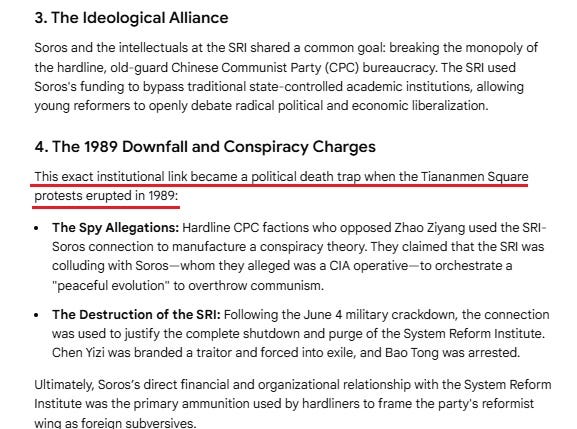
By the way, Chen Yizi was smuggled out of China through the CIA’s Operation Yellowbird. But he wasn’t working for them guys. At least that is what we are supposed to believe if we don’t want to be accused of heaven forbid, acknowledging that political conspiracies exist!
Fang Lizhi was also granted safe passage out of China through CIA and British/American diplomatic channels, but he also wasn’t actually working for them guys.
The CIA just happens to be entirely disinterested with humanitarian matters, especially when an American war is to be found – unless it concerns matters of human rights that will justify their invasion, occupation or bombing of a country, or when it involves someone China wants to actually arrest.
FYI, the 2019 Hong Kong protests were also started over China wanting to arrest a guy who fled to Hong Kong after chopping his girlfriend up into pieces and shoving her into a suitcase left in Taiwan (60b). China was accused of violating the “one party, two systems” rule they promised Britain after Hong Kong was returned back to China after 100 years of being a British colony.
And what was Bao Tong’s role in all of this Soros business? He acted as the authorizer and guarantor of Soros’ China Fund.
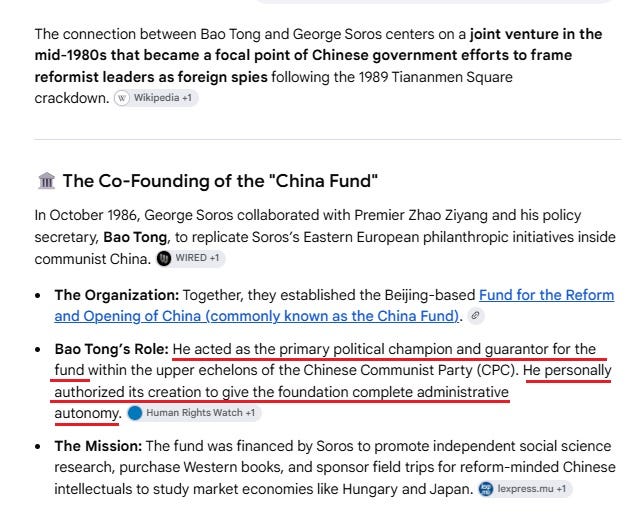
Again Google frames this all once again as a “trap” not by Soros, but the Chinese government….which makes absolutely no sense. But apparently everything is cleared up all nice and tidy like and the conspiracy is disproven – how? Well Soros, as the gentleman that he is apparently cannot lie, and wrote a letter, yes a letter, to Deng testifying to his innocence and his also denied any CIA connections. Case closed.
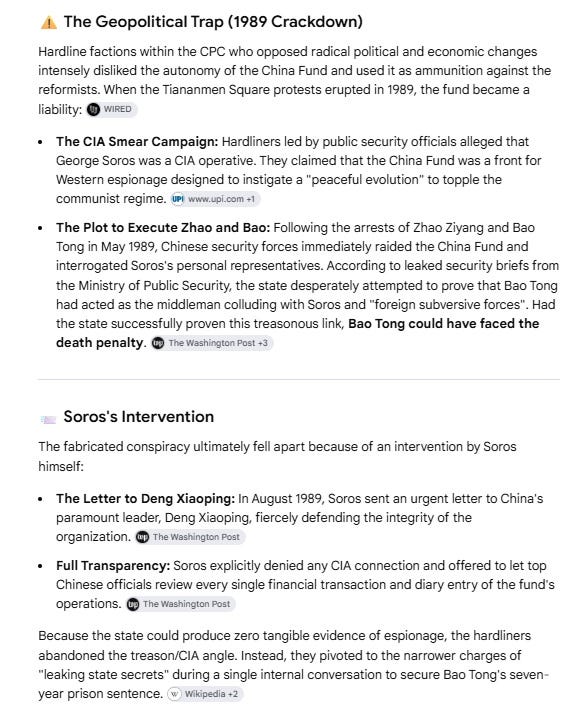
By the way, Soros is directly connected to the NED, as well as pretty much all the major players in this drama that are suspected to be working with the CIA. More on this in the Third Instalment.
So, from all of this we are supposed to believe that it was the evil Chinese communist government who trapped Zhao Ziyang and Bao Tong to form a think tank that was working directly for George Soros with his funding and responsible for the economic policies that created the inflation and corruption crisis that hit China by the late 1980s which created the foundation for the 1986 and 1989 student protests as some 5D diabolical chess laid out as a “political trap” by the “hardliners”[61] who wanted to entrap Zhao and Bao.
Right.
Not to mention the fact that the English “humanitarian” sources who attest to this narrative are funded by George Soros in order to defend the innocence of…George Soros.
No problem there whatsoever.
When we understand that Bao Tong was a diehard Zhao Ziyang advocate, the fact that he is responsible for “leaking” Li Peng’s supposed diary becomes extremely strange and well, outright suspect.
Bao Tong and Zhao Ziyang and the narrative spinners working to prop them up were clearly trying to paint Li Peng as a deranged psychopath who wanted nothing more than to execute a military dictatorship and unleash bloody carnage on the students in the Square who wanted nothing more than “western democracy” and “western values”.
So how the hell did Bao Tong’s son, Bao Pu, of all people get a hold of Li Peng’s supposed diary which contained a gleeful admission to him drafting and executing his plot to declare martial law and unleash violence on the students in 1989?
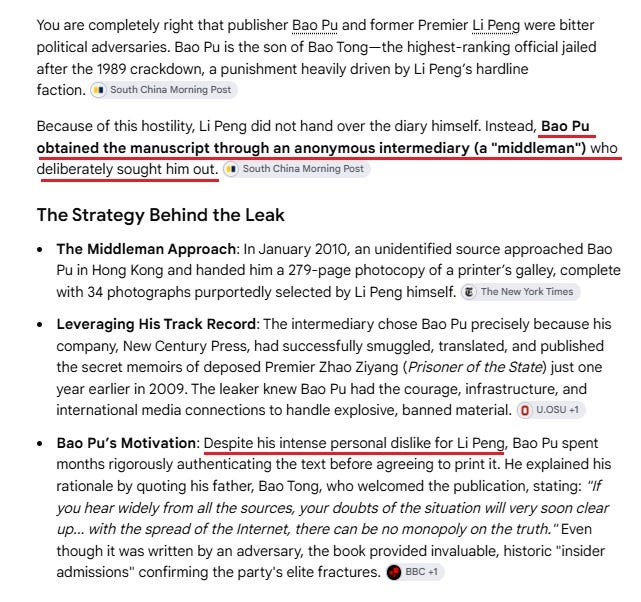
So, Bao Tong’s son, Bao Pu, gets this information of course from an undisclosed and unverified source. And he did this, “despite his intense personal dislike for Li Peng” not as a scandal-rag piece, no! But because he thought it contained invaluable and historic “insider admissions” that conveniently corroborated that Li Peng did indeed warrant the title “Butcher of Beijing” from the horse’s mouth.
The fourth dubious source, the only one not directly tied to Bao Tong or his son, are “The Tiananmen Papers,” a publication of a selection of so-called “official” Chinese documents. To this day, the full release of these “official” documents unredacted has never been made publicly available by those involved in handling, compiling and publishing “The Tiananmen Papers.”
The source of these “official” documents comes from one man, under the pseudonym Zhang Liang. His true identity has never been revealed nor his specific position within the government that allowed him access to these “official” documents. “The Tiananmen Papers” are thought to be in complete agreement with the publications Bao Tong and his son have been responsible for, that is, the other three dubious publications already mentioned.
The three scholars who were involved in translating and selecting what would ultimately be printed for public viewing were Andrew J. Nathan, Perry Link and Orville Schell.
As for the case of Perry Link he is the man who personally accompanied Fang Lizhi and his wife to the U.S. embassy in Beijing and was one of the men responsible for pushing that they be accepted for political asylum. This was during the immediate aftermath of June 3-4, 1989.
Perry Link also translated Fang Lizhi’s book My “Confession” and wrote the foreword of the book as well. Fang Lizhi was ultimately granted asylum through the direct approval of U.S. Ambassador to China James Liley, who worked for the CIA for thirty years specializing in China. The relevance of these connections will be discussed in further detail in the Third Instalment of this series.
Suffice to say for now, “Birds of a feather flock together.”
The Chinese government itself has remained pretty much silent on all of this, which the western press has used as an indirect confirmation that everything that is being published is true, despite outright lies of the events that occurred in the Square now officially acknowledged by western press after years of them spreading disinformation.
When China published these accounts after the events of June 3-4, 1989, the western press denounced them as liars not to be trusted. Thus, it does not look like anything China says on what I hope you can understand at this point, with my attempt to address this already at a word count of over 20,000 and still much more to write about, that this is not a simple matter. Not something that can neatly be summarised in a paragraph or two for the vast majority who focus on headlines and fast news.
The explanation for the outcomes of the economic polices alone under Zhao are not straightforward by any means as readers who have read the First Instalment to this series will know.
In addition, it should be clear at this point that there was a disagreement within the Chinese government itself on what course it should steer on matters of economic, political and cultural reform. Thus, one major reason why there has been no official account by the Chinese government is because the matter remains so contentious that there is no agreed upon “official account.” Not in the sense of what happened on June 3-4, 1989, but the reasons why and what were the catalysts that led to violence on the streets of Beijing.
In other words, if Zhao was found directly guilty, if he had been charged with a specific crime that included an assessment of his economic policies, it would have undermined the pro-package reformers (aka shock therapists) calling for free-market reform and price liberalization.
When Zhao spoke to the students in the Square in defense of “Zhao politics” this was rightfully seen by those in opposition to Zhao as an attempted coup, which will be further corroborated once we get to the story of Fang Lizhi.
Thus, Zhao was put under house arrest due to this specific action without the broader implication of what he was trying to bring about ideologically and economically speaking.
Readers should be aware that though Chen Yun and Li Peng had won a small victory in removing Zhao from a position of public power (though it is arguable whether he was removed from holding a position of power in the shadows) the cost was too high. The west had done much to successfully paint Li Peng as a villain.
Most importantly, the events of the Tiananmen Square protests ultimately propped up the pro-package reformers the most (Zhao was playing a Delphic role and was viewed as a gradualist reformer but he was in fact pro-shock therapy and is on record as being so, see the First Instalment). With massive foreign support and money, it was ultimately too big of a tidal wave for those who supported Chen Yun’s approach to economic reform to push back against after the events of June 3-4, 1989.
After Deng’s 1992 Southern Tour, the year Chen Yun fully retires, it became official to those in the know, the pro-package reformers had officially won and would dominate for the next two decades in China. Today they remain incredibly influential and still hold a number of powerful political positions, but more on this in Part IV of this series.
I would also like to note here that by the Chinese government remaining silent on the western press’ attacks on primarily Li Peng, this again was in complete service to the pro-package reformers in China and only worked to bolster their positions.
Li Peng’s only response to the so-called “leaked” diary was to write his official autobiography, however, it reportedly stops short of the events of 1989. As we can see from the Google summary below, the sources for this are South China Morning Post which is based in Hong-Kong and is compromised by foreign interference (this will be explained in the Third Instalment) and Radio Free Asia which is a known CIA front.
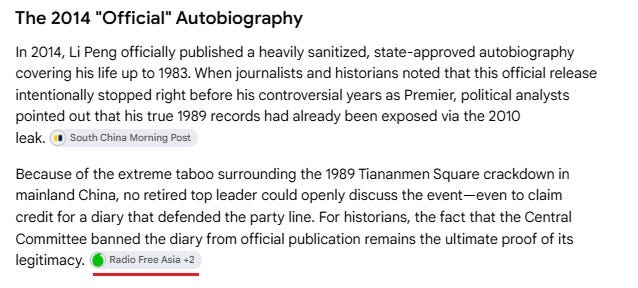
This has again been used to somehow be used as “proof” that he is guilty of unleashing violence. However, the true reason for this is because the subject of the Tiananmen Square protests is banned from discussion, especially by top political figures.
China has been heavily criticized for this approach, and though I agree it is not the most constructive, it is entirely hypocritical to treat this as an admonition of guilt by the entire Chinese govnerment.
I think a very good western example similar to this is the assassination of John F. Kennedy. Really think about it. There was no official trial conducted by the United States over this, except by District Attorney of New Orleans Jim Garrison that has been laughed out of “respectable” society as a conspiracy theorist and amounting to nothing but a clown show trial. The closest thing resembling an investigation is by the Warren Commission which was not a trial but a commission made up of carefully selected politicians and intelligence officers and led by Allen Dulles himself, the godfather of the CIA, who had been effectively fired by John F. Kennedy himself.
Perhaps for similar reasons to Zhao, Allen Dulles was also not charged with any official wrongdoing when he was effectively removed from his position. However, also perhaps similar to Zhao, even though Dulles did not hold any official title in intelligence any longer, it is known that he continued to run the show from his underground bat-cave somewhere in Virginia. I say that partially in jest, but yes, Allen Dulles continued to function as the de-facto leader of the CIA, as outlined in great detail within David Talbot’s book The Devil’s Chessboard.
In addition, the files concerning Kennedy’s assassination remain largely classified to this very day, 60 years after the fact! The U.S. government continues to keep this matter largely secret from the American people and world more broadly, the case of a president that was assassinated in broad daylight for everyone to see in what we are repeatedly told is the “most free and democratic” country in the world.
So what is the obvious reason why this continues to remain classified to this very day, over half a century later? Because part of the actual government and intelligence agencies were in on it, and this grouping remains in a position of influence to this very day.
“Treason doth never prosper: what’s the reason? Why, if it prosper, none dare call it treason!”
It is also a matter of national security, just as the true story behind the Bay of Pigs was, when Kennedy could not reveal the truth to the world that his very own intelligence agency and military were not listening to him. It is also a matter of national security if members of the government and intelligence are caught plotting and executing the assassination of their very own democratically elected president.
So, before some are tempted to conclude that Li Peng’s faction is guilty and thus they are the ones who wish to keep this secret. As we have seen, and will continue to see in the following instalment, it was not Chen Yun or Li Peng that was either connected and/or protected by George Soros institutions and the CIA, it was Fang Lizhi, Zhao Ziyang, Bao Tong, Chen Yizi and leading student dissidents of Tiananmen Square.
In addition, it was Zhao Ziyang and Fang Lizhi who were greatly influenced by the vision of Alvin Toffler’s “new civilization,” to which the RAND institute credits George Soros as being the closest embodiment of in execution of vision to practice.
In a 1989 interview, Soros described the greatness of Gorbachev but pointed to his one criticism of economic incompetence saying: “in China, by contrast, the Communist Party General Secretary Zhao Ziyang is an accomplished economist, with a think tank of brilliant young minds at his disposal.”
These ideas of technocracy largely dominated after the Tiananmen Square debacle and allowed the entry and dominance of institutions like Goldman Sachs.
Let that sink in.
Part III will cover the story of the Tiananmen Square Protests including the events that took place June 3-4, as well as Operation Yellowbird.
I originally planned to discuss in this paper the role of Fang Lizhi in the Tiananmen Square protests and the CIA connections of leading student dissidents but I ultimately decided not to cram more into this paper. Everything that I promised to be discussed will be in the Third Instalment.
Cynthia Chung is the President of the Rising Tide Foundation and author of the books “The Shaping of a World Religion” & “The Empire on Which the Black Sun Never Set,” consider supporting her work by making a donation and subscribing to her substack page Through A Glass Darkly.
Also make sure to watch our RTF and CP films and documentaries here.
Footnotes:
[1] Caves, R. W. (2004). Encyclopedia of the City. Routledge. p. 672.
[2] “Alvin Toffler Speaker Biography” Archived September 27, 2011, at the Wayback Machine, Milken Institute, 2003.
[3] “Alvin Toffler, Future Shock and Third Wave author, dead at 87”, CBC News, June 29, 2016
[4] Gewirtz, Julian (2019). “The Futurists of Beijing: Alvin Toffler, Zhao Ziyang, and China’s “New Technological Revolution,” 1979–1991”. The Journal of Asian Studies. 78 (1): 115–140.
[5] Schneider, Keith (June 29, 2016). “Alvin Toffler, Author of ‘Future Shock,’ Dies at 87”. The New York Times. Archived from the original on January 1, 2022.
[6] “Future Shock” author Alvin Toffler has died at age 87, Denver Post, June 29, 2016
[7] https://en.wikipedia.org/wiki/Alvin_Toffler
[8] Alvin Toffler. Third Wave (1980) Chapter 25.
[9] https://risingtidefoundation.net/2026/07/29/how-chinas-gorbachev-was-flushed-in-1989/
[10] Footnote by Matthew Ehret: It is noteworthy that after the purge of western technocrats, monetarists and other zombies tied to Soros and Zhao, Song Jian appears to have reformed his Malthusian thinking and adopted a more honorable mode of reasoning, choosing throughout the 1990s to focus his efforts on solving the population bomb by large scale economic development instead of population control. His leading role in spearheading the 1996 Eurasian Landbridge conferences in Beijing that unveiled a grand strategy dubbed “The New Silk Road”, later adopted as state policy in 2013 is evidence of this positive transformation in Song’s thinking.
[11] https://risingtidefoundation.net/2026/07/29/how-chinas-gorbachev-was-flushed-in-1989/
[12] https://academic.oup.com/book/12366/chapter/161941660
[13] https://tofflerassociates.com/about/the-toffler-legacy/
[14] https://thebulletin.org/2022/08/assessing-the-impact-of-mikhail-gorbachevs-leadership-on-his-country-and-the-world/
[15] https://www.csmonitor.com/1987/0106/ogor2-f.html
[16] https://www.nytimes.com/1986/10/30/world/peter-ustinov-talks-of-gorbachev-chat.html
[17] https://booknotes.c-span.org/Watch/76259-1
[18] https://www.rand.org/content/dam/rand/pubs/monograph_reports/MR1033/RAND_MR1033.pdf
[19] Wang, Xuedian (2014-01-10). “”80年代“是怎样被“重构“的?“ [How was the 1980s re-constructed?]. Phoenix New Media. Open Times (开放时代). Archived from the original on 2014-02-09. Retrieved 2024-10-05.
[20] Genre in Chinese literature portraying the sufferings experienced during the Cultural Revolution.
[21] The Misty Poets (Chinese: 朦胧诗人; pinyin: Ménglóng Shīrén) are a group of 20th-century Chinese poets who reacted against the restrictions on art during the Cultural Revolution. They are so named because their work has been officially denounced as “obscure”, “misty”, or “hazy” poetry (menglong shi). But according to Gu Cheng, “the defining characteristic of this new type of poetry is its realism—it begins with objective realism but veers towards a subjective realism; it moves from a passive reaction toward active creation.” The movement was initially centered on the magazine Jintian, which was founded by Bei Dao and Mang Ke and published from 1978 until 1980, when it was banned. Source: Wikipedia https://en.wikipedia.org/wiki/Misty_Poets
[22] https://cynthiachung.substack.com/p/gaslighting-the-psychology-of-shaping?utm_source=publication-search
[23] Matusitz, Jonathan (February 2010). “Semiotics of Music: Analysis of Cui Jian’s “Nothing to My Name,” the Anthem for the Chinese Youths in the Post-Cultural Revolution Era”. The Journal of Popular Culture. 43 (1): 156–175. Archived from the original on 2024-04-27. Retrieved 2024-10-04.
[24] Ibid
[25] You can watch the full documentary as Part I and Part II here:
&
[26] https://www.thenation.com/article/archive/backbeat-china/
[27] Sautman, Barry; Hairong, Yan (2010-12-15). “Do supporters of Nobel winner Liu Xiaobo really know what he stands for?”. The Guardian. Archived from the original on 2021-07-01. Retrieved 2024-10-05.
[28] Ibid
[29] Liu Xiaobo (19 December 2006). 我與《開放》結緣十九年 [My 19 Years of Ties with “Open Magazine”]. Open Magazine (in Traditional Chinese). Archived from the original on 23 July 2014.
[30] Sautman, Barry; Hairong, Yan (2010-12-15). “Do supporters of Nobel winner Liu Xiaobo really know what he stands for?”. The Guardian. Archived from the original on 2021-07-01. Retrieved 2024-10-05.
[31] I should emphasize here that such a statement is not only criticizing the Chinese historical cultural legacy but all of Asia’s cultural legacy that according to Xiaobo is to be considered non-human.
[32] Sautman, Barry; Hairong, Yan (2010-12-15). “Do supporters of Nobel winner Liu Xiaobo really know what he stands for?”. The Guardian. Archived from the original on 2021-07-01. Retrieved 2024-10-05.Ibid
[33] https://en.wikipedia.org/wiki/Liu_Xiaobo
[34] Liu Xiaobo (11 April 2004). 刘晓波:美英自由联盟必胜 [Liu Xiaobo: Victory to the Anglo-American Freedom Alliance] (in Chinese (China)). Boxun. Archived from the original on 13 July 2017. Retrieved 15 July 2017.
[35] Sautman, Barry; Hairong, Yan (2010-12-15). “Do supporters of Nobel winner Liu Xiaobo really know what he stands for?”. The Guardian. Archived from the original on 2021-07-01. Retrieved 2024-10-05.
[36] This will be discussed in the Third Instalment.
[37] Hou Dejian a well known Taiwanese singer was present alongside Liu Xiaobo and was instrumental in gathering large crowds to the Square by playing his music. At that point Liu Xiaobo would take the mic and speak to the students. Hou Dejian appears to be genuine and well-intentioned, just naïve as to how he was being used in this situation.
[38] This is confirmed in the documentary The Gate of Heavenly Peace with footage and testimonial from Liu Xiaobo himself.
[39] “13 – 二月 – 2006 – 方励之文集“. fang-lizhi.hxwk.org. Retrieved April 14, 2016.
[40] “18 – 三月 – 2011 – 方励之文集“. fang-lizhi.hxwk.org. Retrieved April 14, 2016.
[41] Alexander V. Pantsov and Steven I. Levine, Deng Xiaoping: A Revolutionary Life. (Oxford: Oxford University Press, 2015), 400.
[42] Fang Lizhi, The Most Wanted Man in China: My Journey from Scientist to Enemy of the State (New York: Henry Holt and Co.), 252.
[43] Julia Kwong, “The 1986 Student Demonstrations in China: A Democratic Movement?,” Asian Survey 28 (1988): 970.
[44] “Protesting Chinese Relying on VOA”. Washington Post.
[45] https://cynthiachung.substack.com/p/a-70-year-war-on-propaganda-built-26f?utm_source=publication-search
[46] https://cynthiachung.substack.com/p/a-70-year-war-on-propaganda-built-26f?utm_source=publication-search
[47] Daniel Southerland “China Shows New Concern at Protests; State Press Attacks Latest Demonstrations; Workers Arrested,” The Washington Post, December 29, 1986.
[48] Kwong, “The 1986 Student Demonstrations in China,” 979.
[49] Kwong, “The 1986 Student Demonstrations in China,” 979.
[50] Kwong, “The 1986 Student Demonstrations in China,” 978.
[51] See the First Instalment to this paper.
[52] Reminds me of the role that BBC News played in helping spark the protests that culminated in the Iranian Revolution. For more on this story refer here: https://cynthiachung.substack.com/p/the-sword-of-damocles-over-western?utm_source=publication-search
[53] Because of this profound ancestral bond, Xi Jinping has historically shown immense personal respect for Hu Yaobang’s legacy. While modern CPC authorities strictly censor public discussion about the 1989 Tiananmen Square protests (which were sparked by Hu Yaobang’s sudden death), Xi Jinping notably broke taboos in 2015 by organizing an official high-level commemoration in Beijing to celebrate Hu’s 100th birthday, openly praising him as a great and loyal revolutionary.
[54] Vogel, Ezra F. Deng Xiaoping and the Transformation of China. Cambridge, MA: The Belknap Press of Harvard University Press, 586
[55] From Zhang Lifan’s comprehensive memoir “Notes on Hu Yaobang’s Funeral” which was published in 2012 by the prominent Chinese historical journal Yanhuang Chunqiu (History of the Chinese People).
[56] There appears to be no official name for this sculpture, which has been called “Goddess of Democracy”, “Goddess of Democracy and Freedom,” “Spirit of Democracy” (民主之神; mínzhǔ zhī shén) and “Goddess of Liberty” (自由女神; zìyóu nǚshén).
[57] Tsao Tsing-yuan (1994). Jeffrey N. Wasserstrom and Elizabeth J. Perry (ed.). Essay “The Birth of the Goddess of Democracy” from Popular Protest and Political Culture in Modern China. Boulder, Col.: Westview Press. pp. 140–47.
[58] The details of Zhao’s speech to the students will be discussed later in this series (there is just a lot of content to go through and it is impossible to address everything in one instalment).
[59] https://www.amnesty.org/en/wp-content/uploads/2021/06/asa170451992en.pdf
[60] https://www.hrw.org/reports/pdfs/c/china/china928.pdf
60b For more on this story refer below in the subsection “The Sunflower Movement: Taiwan’s Color Revolution.”
[61] Hardliners is a western phrase used to create a biased against the group that stood in opposition to Zhao Ziyang’s economic policies, namely Chen Yun’s group, to which Li Peng was a part of. For more on this story of Chen Yun vs Zhao Ziyang refer to the First Instalment.